Lab Numbers Don't Lie — But They Don't Tell the Whole Truth Either: Decoding Cannabis Potency Testing
Photo: Roland Arhelger, CC BY-SA 4.0, via Wikimedia Commons
Walk into almost any dispensary in America and you'll find flower with THC percentages printed bold on the label like a badge of honor. Twenty-six percent. Thirty-one percent. Thirty-four. It's easy to treat those numbers like a straightforward ranking — higher means stronger, right? Grab the top shelf stuff and you're set.
Except it's not that simple. Not even close.
For consumers sourcing cannabis from mountain-region cultivators — think Colorado's high-altitude farms, the ridgeline grows of New Mexico, or the sun-drenched slopes feeding California's northern markets — the gap between what a label says and what your body actually experiences can be surprisingly wide. And the reasons why stretch from basic biology all the way to some genuinely murky testing industry practices.
Let's unpack it.
Why Two Labs Can Look at the Same Bud and See Different Numbers
Here's something the industry doesn't advertise loudly: there is no single, federally standardized method for testing cannabis potency in the United States. Each state that has legalized cannabis sets its own testing requirements, accreditation standards, and acceptable methodologies. Some states mandate High-Performance Liquid Chromatography (HPLC). Others still permit gas chromatography (GC). A handful allow multiple methods without specifying which takes precedence.
Why does that matter? Because these methods don't always produce the same results from the same sample.
Gas chromatography, an older technique, uses heat to vaporize the sample — which converts THCA (the raw, non-psychoactive acid form of THC) into THC as part of the process. HPLC doesn't apply that kind of heat, so it measures THCA and THC separately. If a lab reports "total THC" by combining those figures with a conversion formula, you get one number. If they report only active THC without the conversion, you get a much lower one. The same plant. Different math. Different label.
Add to that the variability in how samples are collected — does the testing batch represent the whole harvest or just the densest, most resinous buds? — and you've got a system practically designed to produce inconsistent results.
Enter Altitude: Where the Science Gets Genuinely Fascinating
Now layer in elevation, and things get even more interesting.
Cannabis plants grown at high altitude face a specific and demanding set of environmental stressors. UV radiation increases significantly as you climb — roughly 10 to 12 percent for every 1,000 meters of elevation gain. The atmosphere thins, temperatures swing harder between day and night, and the growing season compresses. Plants respond to these pressures in measurable ways.
One of the most documented responses is an uptick in trichome production. Trichomes are the resin glands that house cannabinoids and terpenes, and the prevailing theory — supported by multiple independent studies — is that plants ramp up resin output partly as a UV shield. More resin means more cannabinoids. It's the plant protecting itself, and it happens to give us more potent flower as a side effect.
But here's the catch: cannabinoid expression isn't just about quantity. The ratio of THCA to other cannabinoids, the terpene profile, and even the way cannabinoids degrade during curing and drying are all affected by altitude-specific growing conditions. A strain that expresses heavy myrcene content at sea level might shift toward more limonene and pinene at 8,000 feet. Those terpene shifts matter enormously for how a high actually feels — the entourage effect is real — but they don't show up on a standard potency label at all.
So when a mountain grower tells you their crop is unusually potent, they might be right. They might also be showing you numbers that look higher because their testing partner uses a favorable conversion formula. Both things can be true at once.
What Mountain Growers Aren't Always Upfront About
This isn't an accusation — most small cultivators operating at altitude are passionate, knowledgeable people doing genuinely good work. But the testing system creates incentives that can distort communication between grower and consumer.
Because dispensaries and consumers have been trained to chase high THC numbers, there's real commercial pressure to work with labs that produce favorable results. This practice — sometimes called "lab shopping" — has been documented in investigative reporting across Colorado, California, and Oregon. A 2023 analysis by Leafly found statistically significant clustering of test results just above psychologically appealing thresholds like 20% and 25% THC, suggesting the market is influencing the science rather than the other way around.
For mountain-region cultivators specifically, the temptation can be even stronger. If your grow is at 7,500 feet and you genuinely believe your plants are producing exceptional resin, you want the numbers to reflect that story. Sometimes they do — legitimately. Other times, the story gets a little help.
The consumer ends up holding a label that reflects one lab's methodology on one sample from one corner of a harvest, converted using one formula, from a testing partner that might have been selected because they tend to run high.
How to Actually Read a Lab Result
None of this means you should ignore potency labels entirely. It means you should read them more critically. A few things worth looking for:
Check for a full COA (Certificate of Analysis). Any reputable dispensary or direct-to-consumer brand should be able to provide this. A COA breaks down not just THC and CBD but terpene percentages, moisture content, and testing for pesticides and heavy metals. If a seller can't or won't share one, that's a red flag.
Look at THCA vs. THC separately. If a label just says "THC: 30%" without distinguishing between THCA and active delta-9 THC, you're seeing a converted total — which is fine, but worth knowing. Raw THCA numbers can look dramatically different.
Pay attention to terpenes. Especially when buying from mountain-region farms, the terpene breakdown often tells you more about the experience than THC percentage alone. A 22% flower with a rich, complex terpene profile will often outperform a 30% flower with minimal terpene diversity.
Ask where the testing was done. Some states have stricter lab accreditation than others. If you're buying cross-state (where legally permissible) or from a market you're less familiar with, it's worth understanding the regulatory environment the test was conducted in.
The View From Up Here
At Misty Mountain Canna, we believe that altitude is a genuine advantage — the science of high-elevation growing is real, and the plants that come down from those ridgelines often carry something special. But we also think consumers deserve honesty about what those lab numbers actually represent.
The mountain doesn't inflate its credentials. It just does what it does — thin air, intense sun, cold nights — and the plants respond accordingly. The best growers working those elevations know that the story is in the whole plant, not just the percentage on the label.
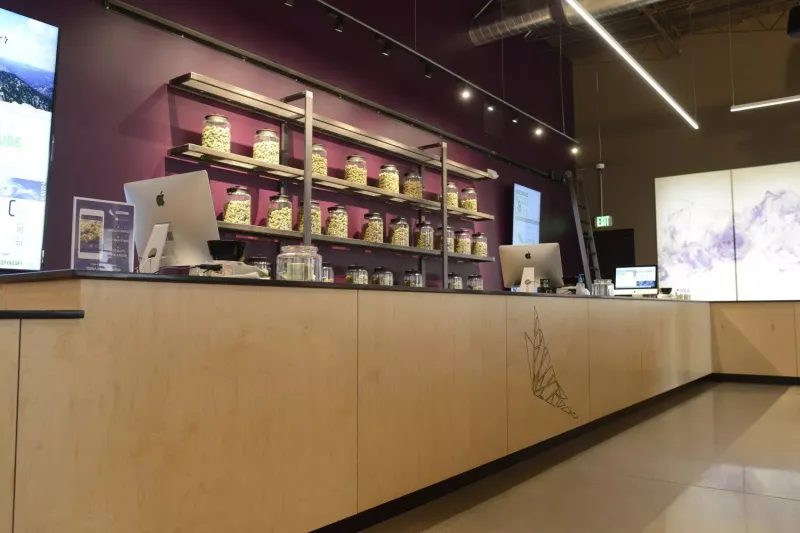
Next time you're staring at a row of jars behind the counter, remember: the number is a starting point, not a finish line. Ask questions. Request the COA. Trust your senses as much as the data.
The peaks have always rewarded those willing to look a little deeper.